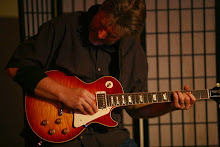
Don Mock 7/2/2003 5:12 PM
Hey guys, Don Mock here ready to talk theory. No other aspect of music is as important to get a handle on than music theory. And it doesn't have to be that clumsy old classical theory either. If you just learn the basics of modern "players" theory you will be armed with enough info to play just about anything. And it's not that hard. If you can understand some basic math, theory will be a snap. Probably the biggest hurdle in theory is learning the "language" of music. There are sometime several terms for the same thing. But once you get past these issues, you will be on your way. So let's talk some theory...maybe I can help, or maybe I can learn something new from you. Let's find out...-Don Mock
clovis 2127/18/2003 8:29 AM
I agree with you Don. The biggest thing that has really made me the musician I am today is my knowledge of the fretboard and music theory. Once I studied Frank Gambale's "Technique Book 1" and saw how over a Dim7 chord (for example) you can substitute all the arps, triads, pentatonics from the key of C major for that Dorian sound, I was well on my way to being a better guitarist. THAT knowledge right there of substituting just the basic diatonic arpeggios and pentatonics, etc from the given key....for any mode..(not even playing "outside" yet) really opened my eyes. Before then I was just playing "Scaluar" licks, runs, etc using the correct fingerboard positions for the scales and not even thinking of chord tones.....Once I moved on to the Melodic Minor scale and studied your book "Melodic Minor Secrets Revealed"...the entire book made immediate sense to me.John
hutz13 1/31/2004 11:23 PM
So what would be step one for a beginner to get a grasp of basic theory?
Don Mock 2/15/2004 12:18 AM
Hutz, Step one is just knowing that there is such a thing called music theory. Step two is knowing that a lot of theory is simple math, and the learning of the "language" of music. What sometimes takes months to learn in a college music theory class can actually be learned in a few short hours. Find a teacher or experienced player to explain to you the basics of theory like the major scale, diatonic harmony and chord construction. It's so simple, yet intimidating when you don't understand it. (the classic example is "modes." When you don't understand modes, they're frustrating and overwhelming, but once you get it, you can't believe you didn't understand it in the first place.) And you should start out learning basic "players" practical theory, not a full blown classical counterpoint theory. There's lots of books out, we even have a few on the subject, but to be honest, a beginner would be better off just spending an hour or two with the right person to take you through basic theory and answer your questions. Or a class at a local music school or Jr. college. Most of music theory is black and white and once memorized, you are done with it. Using and applying it musically in your guitar playing, well, that can take a life time. - Don Mock
lunetta 7/8/2004 5:47 AM
Don,How can a thorough understanding of "modes" lead to my betterment as a guitar player? I can play all the major scale modes, and I understand how they are constructed, but I can't seem to appreciate what all the fuss is about or how to use that knowledge to my advantage. What am I missing?By the way, your melodic minor book was a real godsend for me. I love the way you cut to the chase to explain the real world methods for getting the most out of the cool tonality that the scale can provide. You certainly have a knack for demystifying an abstruse, intimidating subject, and making it accessible to players without fancy-pants music degrees. I'm looking forward to receiving my order for your symmetrical scales book.
Don Mock 7/9/2004 2:56 AM
Lunetta, great question about modes. You are not missing anything. As you have figured out modes are just versions (different starting points) of major scales. Many players do fine not ever thinking in terms of modes as long as they understand major scales and their harmonies or "Key Centers," an approach I teach and use myself in improvising. In defense of modes, they can help you define chords sounds or families. Dorian, for example, is a minor scale and can also be thought of as a "home" for sounds in minor including arpeggios and chords. When I think, A Dorian, I think of Am7, Am9, Am11 Am6 etc. Of course it's just the 2nd scale in the key of G but some guys like to think of modes as separate families. I've seen charts written where no chords symbols where shown, only mode names like: A dorian - Bb lydian - F mixolydian etc. And it is actually a pretty good way to think. BUT, it's still important to know what major keys you are in too. Cause this is where a lot of the useful substitutes come from. Hope this helps. Thanks, -Don Mock
alfonso 8/25/2004 7:04 PM
Don, I'm a long time guitar player, mostly jazz and latin and I've just started learning about modes. I know my major scales and major modes, well most, ionian, dorian, phyrigian mixolydian and aeolian, hope the spelling is right. I didn't yet learn the locrian or lydian, I haven't yet found a use for either one... My question is this, I'm thinkin there's just the melodic minor modes and the harmonic modes, are they separate? Can I just learn one, like say the melodic minor, and change a note or two on each one, to play the harmonic minor? thanks for your timeAlso, I'm working on your Jazz Rhythm Chops video, excellent video, the best and most informative video I own and I really love that Stevens guitar you play on it...
Don Mock 8/25/2004 11:33 PM
Fretboard, thanks for the post. Sounds like you are making headway on the mode thing. But I think you still might be confused about what they really are. Make sure you clearly understand that the seven modes from the major scale are just major scales starting on different roots. C dorian, for example, IS F mixolydian is A locrian is D phrygian etc. And they all are really just Bb major scales. That is it. When soloing over a chord you have two ways to look at it. First. What major key is the chord in? Just play that scale (or key center as we call it). G7...play C major. Fm7b5.....play Gb major. The other way to look at it is to "think" modes. For G7...play G mixolydian. For Fm7b5....play F locrian. It's up to you. Just do not fool your fingers into thinking there are 7 different scales when there is really only one. When you learned your first major scale fingering pattern, you already know all seven modes too. Just start on the different roots in the same pattern. And who solos starting each phrase from the root anyway? I don't even teach new players about modes until they understand key centers. It is a way faster approach to learning improvising.As far as melodic and harmonic minors, I like your thinking. Learn for example, A melodic minor in a few patterns. Then lower all the F# notes to F. Now you have A harmonic minors. And you can play a lot of great ideas for years without ever thinking of these two scales in terms of their modes.Hope this helps - Don Mock
alfonso 8/26/2004 10:00 AM
Don,You're right my thinking is different, maybe even confused. I don't read music very well and that's not how I'm approaching the modes, check out this link and it should explain... I've learned a great deal reading chord charts and working on jazz standards, but I've been limited to the ones I've already heard. It takes a long time to muddle through notes, cause I read notes in a half as manner ... any suggestions? Your screen didn't accept the hyperlink, but in a nutshell, I'm working from patterns. thanks again...http://www.smoots.net/guitarlessons/lesson17.htm
diggity shwag 1/14/2005 6:32 PM
Hi THERE,OKAY, an attempt here (by me :-) ) at trying to learn some of the basics of modern "players" theory?? Are MODAL PLAYING and NON-MODAL PLAYING ever BOTH USED within a single composition????
diggity shwag 1/19/2005 3:37 PM
Another question. :-)What would you say are the prime characteristics of rock?I ask because the language of rock seems a bit vague or random to me. Can you give any insights so that it'll seem less vague?Thank you.
Don Mock 1/25/2005 11:12 PM
Fang, "modal playing" or "non modal playing" are simply two approaches to the same thing. One player in the band might be thinking in terms of modes in a particular tune while another player thinks "key centers." It's all the same stuff, but that's one of the obstacles in learning music, dealing with the fact that there are several ways to arrive at the same point. Your question about rock music is a good one. I hope some other players jump in on this subject/post. I think the confusion with rock is it's heavy influence of blues music. Blues has several hard to define issues in terms of music theory. "Blue notes" for example, are often tones that are not in the key and in classical terms would be considered "wrong." But it's the slang use of these wrong notes in blues that gives it it's soul and identity. Also, rock progressions are often based on unusual or parallel chord moves which are also hard to analyze in traditional music theory. Anyone else have some thoughts? -Don Mock
Thursday, August 27, 2009

Melodic Minor and Targeting
zencat 12/20/2003 2:10 PM
Hi Don, This is a two part question: In your Melodic Minor Book, Unit 6: Using Melodic Minor Arpeggios, paragraph 3, you write: “There are many ways to use the arpeggios of the melodic minor scale. The trick to this is you need to be able to phrase the arpeggios in a way that still communicates to your listener the “sound” of D7…” That was a cliffhanger for me! From what I think you might have meant is that, we should use the notes contained in the melodic minor scale (not the primary chord tones, 1-3-5-7) as passing tones. Put in other words: to place the “altered” notes contained in the scale on the weaker metrical points, and emphasize the chord tones on the strong beats. Is this correct? Can you extrapolate further please? That brings me to question #2, regarding the approach of using chromatics and chromatic/melodic “shapes” to target essential chord tones: It seems to me that the chord scale approach is a lot more cumbersome than the targeting approach. If I keep the appropriate arpeggio in mind while soloing over a given chord, it makes it a lot easier for me to use the “target” approach instead of thinking, melodic minor, harmonic minor, diminished, wholetone, augmented scale, (just a few scale choices) and their modal derivatives. Don’t get me wrong, I love all those scales, and after a number of years of usage, I’m becoming more adept in their application and harmonic potential. They have definitely expanded my improv toolbox. But the other approach of targeting is really begging the question: “Why not take the simpler path?” Any comment on this? Sorry for the length of this post, and thank you for the opportunity to post it. All the best
Don Mock 2/16/2004 12:02 AM
Well Zencat, I now feel like an idiot that I did not respond right away to your great post about the melodic minor and targeting. I guess I thought I had read this one, but just spaced and missed it. No wonder you sent the "waste of time" post a few weeks later. Anyway, lets get to your questions. Any time a player uses any kind on superimposition ideas such as arpeggios and scales etc., the player should try to keep the sound of the chord a priority. It's easy when learning to do this to wonder into the tonality of the tool you are using rather than use the tool to sound the chord for you. Your response is right on the money. Keeping the chord tones emphasized. But this does not necessarily have to be related to strong or weak beats. It is a lot to do with the melodic phrasing too. You nailed the part about targeting. A very valid approach to improvising is to start with arpeggios first, before scales. And reach out to the "other" notes not in the arp. Joe Pass would agree with this. He was all about chord tones and melodies. "Screw the scales" said Joe on numerous occasions. In the big picture, all the paths end up at the same place. It's like the old GIT "West Coast" key center approach vs. the Berklee "East Coast" modal approach. Both get you the same end result. At GIT we told student at first to just play the C scale through a I-VI-II-V progression in C. Then add arpeggios for each chord next. At Berklee, you learn four complete scales-modes for the same progression. I think the key center path is physiologically faster cause it gets people playing faster. But in the end they still have to learn to sound each chord. Well enough of me rambling on. You hit on a lot of great points and I hope that a lot of player read what you said...should give them something to think about. So Zencat, come on back and add some more, it was great. - Don Mock
Whole Tone Ideas
gill 2/26/2004 6:02 AM
I would like to know more about how to use a whole tone scale. I use it a little in my playing but I need a broader picture of how to use it and really make it work. also using Lydian flat 7 ideas. Thanks gill
Don Mock 2/27/2004 9:03 PM
Thanks for the post Gill. I hate to promote my books too much but heck both the scales you mentioned I have written pretty involved books on the subject. I just finished the "Symmetric Scales Revealed" book and it's almost an over kill on the diminished and whole tone scales. I wrote it nearly 3 years ago but didn't get around to recording the CD for it until a few months ago. And it was a bit tough cause I forgot a lot of the lines and examples that I had written. But it's done now and came out pretty good. The whole tone section shows lots of sequences, and fingerboard shape ideas as well as lots of licks. It's pretty much a dominant 7th scale but can also be used over a few other situations. The other scale "Lydian b7" is really a melodic minor and I "wrote the book" on that one too "Melodic Minor Revealed". G Lydian b7, by the way, is actually D melodic minor. Some like to use the modal names, (Lydian b7) but you can also do really well using the "key center" approach, which in this case over a dominant 7th, play a melodic minor "up a fifth." Same result, just don't have to learn the 7 modes of melodic minor. -Don
Soloing Thoughts
mmms 3/15/2004 4:42 AM
Hi Don; Listening to your "Speed Of Light" CD I was very impressed by the soloing in both St. Clair & Robben's Bebop Blues. Both quite different in their chord structure. St. Clair more "vamp" oriented and Bebop more "changes" oriented. What are your basic thoughts in soloing to these different types of songs. Thanks. Nice to see all the new books and videos on the web site!
Don Mock 3/15/2004 6:58 PM
mmms, thanks for the post. You threw a pretty good but tough to answer question about soloing over the two types of tunes. St. Clair is a tune I wrote during the early years at GIT. It's kind of a study in lydian dominant. The melody is based in A melodic minor over D7. The chord changes are modal meaning that they are all dominant chords moving down thru different keys (F#11, E11, D11, C#11, B11 and A11). The blues is basically a jazz style blues and I player (or overplayed) lots of traditional jazz lines mixed with my intervallic and outside concepts. It does show how when you use a modern sound and some other soloing ideas you can get a lot out of the melodies from the masters like Charlie Parker, Coltrane etc. thanks - Don
szulc 12/8/2004 11:54 AM
I have studied theory for a long time and have recently become aware of less theoretical approaches to ii V, where you spell out notes of the IV and V triads sort of randomly or move ideas (motives) up in Minor thirds. I have been hearing a lot of this type of thing especially in Wes Montgomery's playing. I am wondering if people here have some similar ideas that are less theoretically challenging but work well such as these ideas? Because the whole range of Melodic minor possibilities is mind boggling, and I want something less mentally taxing to get me through some of this.
Don Mock 12/8/2004 7:56 PM
Szulc, thanks for dropping by and for the good questions. Yes, there seems to be millions of possibilities of things to do with melodic minor or any superimposed ideas over dominant chords. But the theory is pretty simple. I would really like to talk you into exploring the theory so you can clearly understand how chords and scales work. It's pretty basic math, and once you get it, you are done. There is only so much theory. Then you spend the rest of your life trying to apply the ideas. That's the hard part.As far as minor third movements, one popular idea is to play major triads up minor thirds from the root of a dominant 7th. (G7 use: G, Bb, Db and E major triads). It's actually a diminished scale trick as all the notes are in the scale. There are many motifs you can invent and repeat in the four triads. Hate to push my books on you but there is a pretty detailed section in my new book " Symmetric Scales Revealed" on major triads in diminished. And the theory is laid out too. And check out the Melodic Minor book from the same series. I tried to simplify the uses of melodic minor. An important thing to remember in dealing with what seems to be mind-boggling amounts of theory and concepts is: All great players only use a very small amount of these ideas. I may know every use of every scale and all the theory on the planet, but when it comes to playing, I only use very few things that I like and can use. No one can apply it all. Just pick a few cool things that you like and stick to them. You will be much more successful and have a lot more fun. -Don Mock
szulc 12/9/2004 1:21 PM
Don,I have read several of your earlier works (artful Arpeggios comes to mind) also seen many of the videos you have produced for (REH?) .I have a strong math background since I am an engineer the math is the easy part for me (I have authored several very cool articles for Ibreathemusic for instance http://www.ibreathemusic.com/article/138which talks about tritone and m3 substitution from a mathematical perspective. there is even a cool spreadsheet to help figure out which chords can be safely moved in m3.)I know many of the substitution rules and uses for symmetrical scales and 15 different ways to use Melodic minor over Alter chords. The problem I have is putting them into practice and simplification of the ideas down to simple things like spelling out various major and minor triads out of the dim scale to make it sound less boring.I want to read you new books and will as soon as they arrive.I have lots of cool ideas but I am always looking for more cool ideas, preferably simple ones like blowing over changes using notes of triads like the Larry Carlton thing he mentions in his video.
Don Mock 12/9/2004 7:21 PM
Szulc, sounds like you have a pretty good idea of the theory side, just frustrated, like the rest of us, trying to make music out of the mechanical stuff. My thoughts for you is to really spend time transcribing or copying players that you like. Figure things out, write them down and then analyze the theory behind it. The main thing is to use things you learn. Keep things simple. It's much better to have only a few things down than too many ideas that you can't play. Every great player I know has a fairly small repertoire of licks and concepts. But they know how to get lots of miles out of each idea. I hope you like the books and be sure to send me any questions or comments about them. -Don Mock
Don Mock 12/9/2004 7:33 PM
James, I just read your article and visited your web site. Very cool stuff and the tritone ideas were great. As a fan of Coltrane myself, I've also worked alot on these kinds of things. Hope we keep hearing from you. -Don Mock
szulc 12/21/2004 10:22 AM
I bought the "Blues from rock to Jazz" video and "intervallic designs" (Joe Diorio) from this site. I am hoping that these will help me in my quest. I have been wanting the Diorio book for a while but this was the only place I could find it new. Somehow the Blues video peaked my curiosity because I already can play reasonably well through Blues changes and it seems to be used as a vehicle for learning to play through the changes as a jazzer would. I am Wes fan and I was impressed by the Artful Arpeggios book and the playing on the tape. I may revisit that one before I try to move one to some of the more complicated topics.I have been toying around with the Diminished scale picking out major and minor triads to "break up the outline" (This reminds me of the purpose of camouflage) and it seems to help with using this in a more musical way. I am anxiously awaiting the arrival of these new lessons.
Don Mock 12/23/2004 12:59 AM
James, you named two of the greatest to ever touch a guitar...Wes and Joe. I'm proud to be a friend of Joe Diorio's and his Intervallic Designs is a great book. It is one of the early REH books done during the first year or two of GIT in about 1978. Joe and I and Ron Eschete would hang out together playing in the office when ever we had free time. It was a wonderful and inspiring time for all of us. Both are such great players but Joe really struck a nerve with me. His was playing all the intervallic things I was working on and was a great be-pop player too. I helped him with the book and although it did not sell very well, it has some of the best interval and outside ideas ever published. I go through it myself from time to time to get new ideas. You are also right about the blues. It is the heart and soul of jazz and the 12 bar progression is a great vehicle to learn about playing through jazz changes. It's the one tune that you can play straight blues and slowly add more advanced concepts as you go and still sound good. I use it all the time in my teaching to introduce jazz improv ideas and concepts. Have a good holiday season everyone. -Don Mock
diggity shwag 12/28/2004 4:45 PM
Hello Don,This discussion struck a chord with me (sorry for the pun).You said quote:"An important thing to remember in dealing with what seems to be mind-boggling amounts of theory and concepts is: All great players only use a very small amount of these ideas. I may know every use of every scale and all the theory on the planet, but when it comes to playing, I only use very few things that I like and can use. No one can apply it all. Just pick a few cool things that you like and stick to them. You will be much more successful and have a lot more fun". -Don MockWell I feel like I've focused too much on learning theory and haven't done enough in terms of 'applying' that information. Therefore I've barely retained any of the info.There are alot of conflicting ideas expressed out there with regards to modal and non modal playing. When and where does one need to be thinking "modally" and when and where does one need to be thinking "non modally" and do these modal and non modal playing concepts ever co-mingle within a single composition? In other words can you transition between the two?Is that just a modulation issue?Anyways how can I get organized and focused on the right things? Any tips for getting really organized in terms of the Major Scale and it's modes? Cause I would like to feel like I've got that down before moving on to all of this altered dominants and melodic minor modes business. I feel like it would be less mentally taxing if I could get somewhat organized.Any advice would be really great.
szulc 1/5/2005 7:55 AM
I received the Blues from rock through jazz video yesterday.I have absorbed most of the stuff.You talk about using C7, Em7b5, Gm7, and BbM7 in there and I get it but isn't that just another way to look at?C7 (C9 3,5,7,9) (C11 5,7,9,11) (C13 7,9,11,13 )CEGBb, EGBbD, GBbDF, BbDFEI really hear it this way and not so much as C7,Em7b5 etc...I guess that is the point here.I am pretty much abbreviating this to just thinking in terms of C and Bb Major which seems to be working if I approach the 3rds( and sometime the 7th) from a half step below.Don, the playing on this is fantastic, but the distorted guitar tone is not very tubey, sounds like a stomp box.I am trying to get the stylistic way you are using chromaticism to lead into chord tones. It also appears to me there are several ideas on your improv based on 4ths or 5ths.I am also trying to read through the Joe Diorio intervallic designs book. I guess I am a little disappointed with it because it seems so much like Jerry Cokers patterns for Jazz, a bit too cookbookish.I am having trouble getting the sound of the three Major Pentatonics in my head for blowing over each Dom7 in the blues prog.Can you suggest a good method for this?My personal approach to blues soloing up till now is mostly Blues scale based over the I chord with emphasis on the M3 usually m3 is a passing tone or is bent towards M3. Over the IV chord I like to usea pent based on 1 b3 4 5 6 (where 4 is the root of the IV) I guess it is equivalent to a IV9 arpeggio. In any event the emphasis is on the M3 of the chord or (M6 from the Key).I like to use the tritone shifting chromatically where 3 becomes 7 and 7 becomes 3.The V chord seems to present many possibilities but I favor V7(sus4)11. Basically a V Minor Pentatonic with M3 replacing m3.I like to try and emulate Wes and sometimes use Dorian with an added #4/b5. This seems to give me the BeBop thing.The line you use over the turnaround (key of G - G7 E7 Am7 D7)Seems to be (C Major) A Harmonic Minor and then G Harmonic Minor.I have an abersald thing that has hundreds of little motives useful for cycle 4 turnarounds depending on how far out you want to take the alterations.It seems that this same line would work if the A chord was major or A7. So I guess it is pretty much a cycle 4 thing also.It is funny because it reminds me of a line from Paganinni's Moto Perpetuo. I guess Niccolo was thinking of a turnaround way back then.
szulc 1/11/2005 7:08 AM
questions (for Don),In the Blues From Rock to Jazz video, you play three example solos at the end. How were these composed?Did you improvise them then transcribe them? OrDid you plan them out then learn them?Orsomething else?I hear big Pat Martino influences on this video (Diorio as well in solo 3).When was this made ?If you were to plan out a solo over basic blues changes would you use targeting on the 3 and 7 of every chord?What kind of synth was that at the end of this video?Was it triggered by hammering on, or is there wires making contact in the frets?
Don Mock 1/14/2005 1:42 AM
Wow, Szulc, a lot of really good observations and points in your two posts. Where do I start?The questions first. Just remember I recorded the Blues to Rock video a long time ago so I can't remember exactly what went on. The jazz/blues solos at the end were composed and written out first. They're made up of smaller lines that I play all the time but connected them into more "exercise" sounding lines. I really learned a lot by doing things like that. Write out the solos you wish you could think up on the spot and learn them. Before long you will start sounding pretty close to it. Yes. Pat Martino is a good friend and huge inspiration as is Joe Diorio. I have a suite of three tunes that I'm recording this spring. It's called "Martorio Suite" for Joe and Pat. Targeting 3rds and 7ths are always good tones to resolve lines to but lots of other work if the melody works in a way to take you there. That's my old Lane Moller double neck synth. It's a one of a kind guitar with wired frets on the top neck. Tracking is instant but it's monophonic and you can't play with dynamics. It was my big thing in the '80's where I could play millions of fast notes but it got old and now I back to the Roland system which has gotten pretty good. I have pickups on a Tele and my Stevens guitars. So James, I wish we could hang out and I could hear you play. I sure would have a better idea of how to help. Maybe if you are in the Seattle area sometime, you can visit RMI, a new school I'm involved with here with Jay Roberts (Howard's son). It's going to be a great little school with lots going on. Feel free to send me a mp3 of your playing if you want. I'll give you some positive feedback. mock@guitaraxis.com. Sorry you were disappointed with Intervalic Designs. Give it some time and get some of Joe's recordings to hear the stuff being used. Joe is the one of best there is.That's it for now. We're all headed to LA for the NAMM show next week. Hope to see lots of friends and players and what's up with the music business. -Don Mock
szulc 1/14/2005 3:18 PM
I am reading the Intervallic designs every night while watching/(listening to) the news. I guess mapping out solos is a good way to start blowing over chord changes. I have always had an aversion to that. I had an instructor in college that was an awesome Tenor Sax player and he gave me aebersald tapes of chord changes but wouldn't give me the charts he said "Use your Ears". I guess I was supposed to be able to figure that stuff out by ear. I wasn't very good at that! Now I am going to start reading/learning other people's solos and trying to make them part of my vocabulary.I wrote out the first and third solos in your video in Powertab (it shows TAB and Staff). Mostly I did this because I didn't want to leave the VCR on pause too long. I could post them if you want.Maybe tonight I'll tab out the middle one.
Don Mock 1/16/2005 2:35 PM
Szulc, yes, trying to use your ears is a pretty tough way to go about soloing over changes. You can't "hear" what you don't "know." Ear training is really about learning sounds so you recognize them later on.We're planning to convert the Blues Rock to Jazz video to DVD and will include a booklet. In the early REH videos we put the music notation on the screen but it's awful to try to read. I could really use any notation you have written out. I can't find the originalmusic examples so it would be very helpful, especially the tab which we did not put on the screen. Thanks, -Don Mock
Chromatics
bluesyourdaddy 2/15/2005 9:32 PM
Don, I have all of your Secrets Revealed books and two of your videos. I have been applying what I have learned and have been very happy with the improvement of my ideas when improvising. My question is about adding chromatics. Do you have tips about any methods to adding chromatic ideas? I know it is obvious that you can basically add notes in between the scales and arps. But when you show examples that skip around I wonder how you come up with those chromatic ideas that come from all directions. Thanks, Brian
Don Mock 2/16/2005 10:14 PM
Great to hear from you Brian. I hate to push my books sometimes, but I think my new "Masterclass Series - Target Tones" is probably what you are looking for. It is a concept for using chromatics through the use of small four-note "target melodies" that lead to chord and scale tones. I think you will get a clearer view of how chromatics work in improvising. Getting chromatics in your playing is not about using the chromatic scale, but more how the "wrong" notes can work to enhance the "right" ones.-Don Mock
Composing
diggity shwag 3/2/2005 9:02 PM
How are functional and non-functional harmony used in songwriting? Can both be used within a single composition? Is that something that is commonly done? I have no clue. Help. thangx ;-)
marcbabin 4/16/2005 10:23 AM
Do you mean by functional diatonic and non functional altered or atonal??
diggity shwag 4/17/2005 4:04 PM
"Do you mean by functional diatonic and non functional altered or atonal??"I think so. Sort of. Maybe not atonal per se. I mean, diatonic chords are moving towards their goal and that's how you place the changes knowing that the tonic of the key is their destination. But then with modes you don't have all of that happening and you're just kind of droning on the modal root. So let's say you get tired of droning on that one modal root and you want to go somewhere else because you feel that a change should occur. Where do you go? You want to modulate right? So I guess I'm trying to figure how to put that together (or if I can) with regular diatonic changes. And also I wouldn't mind any insights on root movement of chords that don't follow a diatonic pattern. I mean any chord can follow any other chord if it sounds good right? Could anyone shed some light on any of this stuff?
Don Mock 4/20/2005 2:42 AM
Let me take a shot at this. A lot of great question/ideas, but maybe we should separate a few of these issues to be clear on each. First, how about some terminology. Jazz players and composers tend to think of the word diatonic as meaning "relating to" or "part of" etc. Some even use the word when talking about any key center which might include harmonic or melodic minors. Ebmaj#5, for example, is "diatonic to the key of C harmonic minor etc. But it's probably best to stick to the major scale when using the word. In my world the term "functioning" is almost always attached to a dominant 7th chord. Functioning dominants always take you somewhere else usually, but not always, the tonic chord. (G7 to Cmaj7 or A7 to Dm7 etc. Dominant 7ths that are stationary like the ones in blues, rock or funk are sometime called "static dominants." Static dominants can usually have extensions added (9th, 11th, 13th) but not usually alterations (#5, b9 etc). The one big exception in modern music is adding the #9 to a static dominant. (Check out my little lesson on "The Hendrix Chord" here on the site.) One right thing you said is that any chord can follow any chord if it sound good. There really are no strict rules on how one constructs a tune. Although, the chord moves that sound great usually follow some logic or harmonic movement that works and can probably be traced to some classical rule. Traditional tunes and jazz standards are loaded with common short progressions such II-V-I and I-VI-II-V's. You can connect these progressions from key to key all day long and will always sound correct. Randomly play turnarounds in any key to any key and you will see that you can't sound wrong. We can call this kind of composing "diatonic progressions" even though we might be changing keys every bar. Some other terms that you might hear relating to improvising and composing are modal and parallel chord movements. During the fusion era in the '70's and '80's everyone was writing tunes with parallel moves. Heck, just take an A11 or G/A chord and slide it around to different keys every bar or so. Instant fusion. Entire tunes are written with one chord played in several keys. My tune St. Clair is nothing more than an dominant 11th played in about 6 keys. And these 11th's are considered "static" dominants so you won't hear much in the way of altered sounds.Modal writing is using the mode names to not only tell you which scale you are in but also the harmony or chords. When you think about it, writing out tunes using this approach makes a lot of sense. If I see on a chart a bar of D Dorian, I have all the information I need to not only improvise but comp too. D Dorian is nothing more that a C major scale for soloing and for chords I can play Dm, Dm7, Dm9, Dm11 and any Dm chords with extensions or additions from the key of C. If the next bar has F Phrygian, off to the key of D flat and the same thing. D flat for my key center and notes from Db added to the Fm chord. Well I've skimmed over a lot of ideas here but the bottom line is all this leads us back to the need for a clear knowledge of harmony and theory. And learning theory is easy, it's using it in a creative and musical fashion that can take a life time to master.-Don Mock
Modulation Question
diggity shwag 6/14/2005 5:28 PM
When modulating (in modern music), is a PAC (perfect authentic cadence) required in the new key, or is that just one of those old school rules particular to classical music?
Don Mock 6/16/2005 2:27 AM
Quite a question there Feng. There are no real rules in modern music about key modulations. Compositions can change keys anytime if it sounds good. And you don't need a classical cadence to lead into a key change. Jazz players write tunes all the time that shift keys using either traditional progressions (II-V-I etc.) or modal or parallel harmonies. Look at a tune like "Maiden Voyage" by Herbie Hancock. It's just the same 11th chord shifting to different keys. Or how about Miles Davis's classic "So What." Two chords......Dm7 and Ebm7. Two keys that are not related and you don't need to try to use leading chords (V to I) to make the tune sound good. -Don Mock
Subscribe to:
Posts (Atom)